Kakamega Forest is Kenya’s only tropical rainforest, a surviving fragment of the Guineo-Congolian forest that once stretched across Central Africa. It sits in western Kenya, about 418 km from Nairobi and roughly 50 km north of Kisumu, and is explored on foot with local guides for its birds, monkeys, butterflies and giant trees.
Most visitors know Kenya for open savannah, so planning a rainforest stop raises fair questions: which side of the forest to visit, how to get there, what it costs and when the rain is lightest. This guide answers each one with checked facts, a sample itinerary and honest advice on who will love the forest and who may not.
Quick Facts
- Location: Kakamega County, western Kenya, about 418 km from Nairobi by road
- Altitude: Roughly 1,550-1,650 m above sea level
- Size: About 238 sq km of forest ecosystem, less than half of it intact indigenous forest
- Wildlife: About 330 bird species, 7 primate species and over 400 butterfly species
- Gate hours: 06:00-18:00 on the KWS reserve side unless you stay overnight
- Non-resident fee: USD 50 per adult on the KWS side (checked October 2026)
- Best for: Birders, walkers, photographers and travellers who have already done the big parks
What Is Kakamega Forest and Why Is It Special?
Kakamega Forest is the easternmost remnant of the Guineo-Congolian rainforest, the same forest belt that covers much of Congo and Uganda. That link explains why it holds birds, primates and plants found nowhere else in Kenya.
Rainfall here averages around 2,000 mm a year, and the canopy is layered with figs, climbers and tall hardwoods. The Kenya Wildlife Service records more than 380 tree species here. Many West and Central African species reach the eastern edge of their range in this forest, so a walk here feels closer to Uganda’s Kibale than to the Masai Mara.
Ready to go? Book your customized safari instantly on WhatsApp — we'll take it from there.

Instantly on
The forest has been under protection for a long time. It was first gazetted as a Trust Forest in 1933, and its northern block became a national reserve in the mid-1980s. Despite that, the forest has been heavily logged and settled in the past, and today less than half of the ecosystem is intact indigenous forest.
Buyangu and Isecheno: the two sides of Kakamega Forest
The forest is managed in two parts. The northern Buyangu area, together with the small Kisere block, forms Kakamega Forest National Reserve, run by the Kenya Wildlife Service. The southern Isecheno area is managed by the Kenya Forest Service and is where many local guide groups and the basic forest guesthouses are based.
Both sides offer good birding and walking. Buyangu has the KWS facilities, Buyangu Hill viewpoint and the trail to Isiukhu Falls, while Isecheno is popular for Lirhanda Hill sunrise walks and easy access to village guides. Fees are paid separately on each side, so most travellers base themselves on one side rather than switching between them.
| Section | Managed by | Highlights | Suits |
|---|---|---|---|
| Buyangu (north) | Kenya Wildlife Service | Buyangu Hill viewpoint, Isiukhu Falls, Mukangu trail giant tree | Travellers who want reserve facilities and campsites |
| Isecheno (south) | Kenya Forest Service | Lirhanda Hill sunrise, community guides, forest guesthouses | Birders and budget travellers |
| Kisere (north) | Kenya Wildlife Service | Small, quieter forest block next to Buyangu | Keen birders looking for less-visited trails |
What Wildlife Can You See in Kakamega Forest?
This forest is about small and colourful wildlife rather than big game. Expect monkeys in the canopy, a constant chorus of forest birds, clouds of butterflies on sunny trails and the odd chameleon or snake if your guide has sharp eyes.
The Kenya Wildlife Service lists about 330 bird species, seven primate species, more than 400 butterfly species and 27 snake species. Mammals you are unlikely to see without luck include the giant forest hedgehog, bushpig and clawless otter.
Primates
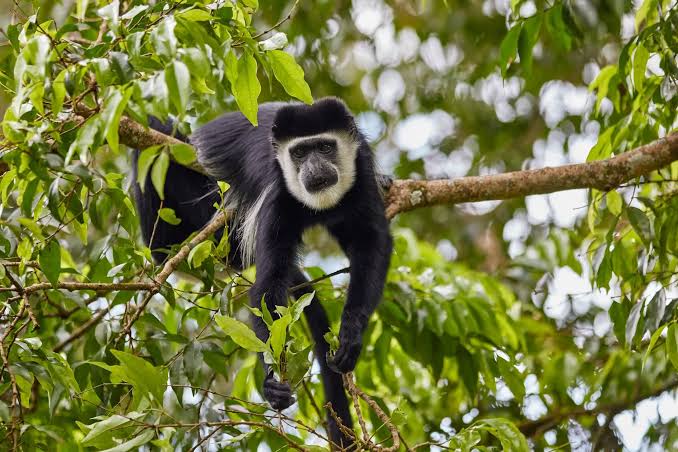
Black-and-white colobus, red-tailed monkeys and blue monkeys are the most common sightings, often seen feeding in fig trees near the trails. The rarer De Brazza’s monkey, with its white beard and orange brow, lives in the reserve too, and the nocturnal potto is one of the reasons people book a guided night walk where one is offered.
Birding in Kakamega Forest
Birding is the main reason serious naturalists come here. The great blue turaco is the showstopper, a large turquoise bird that crashes between treetops, and the blue-headed bee-eater is a favourite with photographers.
Specialists to look for include Turner’s eremomela, a globally threatened species, plus Jameson’s wattle-eye, red-headed malimbe, blue-shouldered robin-chat and a confusing range of greenbuls. A local bird guide makes a huge difference, because most forest birds are heard long before they are seen.
Butterflies, trees and reptiles
On a bright morning the trails and stream crossings fill with butterflies, including forest species found nowhere else in Kenya. Your guide will point out medicinal plants, strangler figs and very old hardwoods, while chameleons and the occasional forest snake add interest for patient walkers.
Top Things to Do in Kakamega Forest
The forest is explored on foot. The main activities are guided nature walks, dawn birding, hill viewpoints for sunrise or sunset, waterfall hikes and, where available, guided night walks to look for nocturnal animals.
| Activity | Where | Time needed | Good to know |
|---|---|---|---|
| Dawn bird walk | Either side, near forest edges and glades | 2-3 hours | Start at first light when birds are most active |
| Buyangu Hill viewpoint | Buyangu (KWS) | 2-3 hours return | Sunrise views over the canopy |
| Lirhanda Hill sunrise or sunset | Isecheno (KFS) | 2-3 hours return | Short steep climb; bring a torch |
| Isiukhu Falls hike | Buyangu (KWS) | Half day | Slippery after rain; good shoes essential |
| Guided night walk | Ask guides on arrival | 1-2 hours | Only possible if you stay overnight |
Guided walks are worth every shilling. Trails branch often, signage is limited, and a guide who knows the calls will find twice as many birds and primates as you would alone. Book guides at the KWS office at Buyangu or through the guide groups at Isecheno, and agree the route, duration and price before setting off.
How Much Does It Cost to Visit Kakamega Forest?
Visiting the rainforest is cheaper than most Kenyan safari parks. On the KWS reserve side, non-resident adults pay USD 50 per day and children USD 25 (checked October 2026). Guide fees, transport and accommodation make up the rest of the budget.
| Visitor | Adult | Child |
|---|---|---|
| Non-resident | USD 50 | USD 25 |
| Kenya resident | KES 675 | KES 350 |
| East African citizen | KES 500 | KES 250 |
These are the conservation fees listed in the Kenya Wildlife Service guide to Kakamega Forest National Reserve (checked October 2026). Payment is cashless through Kenya’s eCitizen system. The Isecheno side charges its own fee to Kenya Forest Service, so check the current rate before you go, as fees in Kenya change from time to time.
Getting there is the bigger cost. A private road transfer from Nairobi takes most of a day each way, so many travellers fly to Kisumu and drive from there. For a sense of how a forest stop fits into a wider budget, our Kenya safari cost breakdown covers park fees, vehicles and lodges across the country.
How Do You Get to Kakamega Forest?
The fastest way to reach the forest is to fly from Nairobi to Kisumu, then drive about 50 km north. By road from Nairobi the trip is about 418 km via Nakuru and Kapsabet. Flights to Eldoret are another option for travellers coming from the north.
| Route | Distance | Typical time | Notes |
|---|---|---|---|
| Nairobi to Kakamega Forest by road | About 418 km | 7-8 hours | Via Nakuru and Kapsabet; break the drive at Lake Nakuru |
| Kisumu to the forest | About 50 km | 1-1.5 hours | After a short scheduled flight from Nairobi |
| Kakamega town to Buyangu | About 18 km | 30-45 minutes | Along the road towards Webuye |
Driving times above are realistic estimates that allow for traffic, roadworks and the final stretch on rougher roads. If you are coming by road, it makes sense to split the journey with a night in the Rift Valley. Our Lake Nakuru safari guide and our post on Lake Bogoria’s geysers and flamingos show two easy stops on the way west.
Sample 4-day Kakamega Forest itinerary from Nairobi
| Day | Plan | Overnight |
|---|---|---|
| Day 1 | Drive Nairobi to Lake Nakuru; afternoon game drive for rhino and flamingos | Lake Nakuru area |
| Day 2 | Continue west via Kapsabet; afternoon forest walk | Forest edge |
| Day 3 | Dawn birding, Buyangu or Lirhanda Hill, afternoon Isiukhu Falls hike | Forest edge |
| Day 4 | Early bird walk, then drive to Kisumu for a flight to Nairobi | Nairobi |
Add Kakamega Forest to a Kenya safari
Browse our tailor-made Kenya safaris with private vehicles and local guides, and we will build the rainforest into your route.
When Is the Best Time to Visit Kakamega Forest?
The rainforest can be visited all year, but the drier months from December to February usually give the easiest walking. Rain falls in every month in western Kenya, with the heaviest showers typically from March to May and a second wet spell later in the year.
Rain usually comes as afternoon storms rather than all-day downpours, so mornings are often clear even in the wetter months. Birding is good all year, and the wet season brings breeding plumage and more insects, though trails become muddy and slippery. Butterflies are at their best on sunny mornings after rain.
| Period | Conditions | What it suits |
|---|---|---|
| December-February | Drier, sunnier, firmer trails | Hiking, photography, first-time visitors |
| March-May | Wettest months, frequent heavy storms | Keen birders who do not mind mud |
| June-September | Mixed sun and showers, green and lush | Combining with a Masai Mara migration safari |
| October-November | Showers return, quieter trails | Budget travellers and birders |
Because the forest lies at around 1,600 m, days are warm but nights can feel cool, especially after rain. Pack a fleece for early starts.
Where to Stay Near Kakamega Forest
Accommodation here is simple. Choose between KWS campsites in the reserve, basic forest guesthouses at Isecheno, a small number of private lodges at the forest edge, or hotels in Kakamega town, about half an hour away.
The Kenya Wildlife Service lists Udo and Biota campsites in the reserve for self-sufficient campers. Staying inside or right beside the forest is worth it, because it lets you be on the trails at dawn and makes a guided night walk possible. Hotels in Kakamega town offer more comfort but mean a drive before every walk.
Insider Tips
- Start early: Be on the trail by 06:30; birds and monkeys are most active in the first three hours
- Hire a local guide: Agree route, time and price first; guides find far more wildlife than self-guided walkers
- Waterproofs: Pack a light rain jacket and a dry bag for your camera, whatever the month
- Footwear: Wear closed walking shoes with good grip; gaiters or tucked-in trousers help with safari ants
- Binoculars: Essential for canopy birds and primates; 8×42 suits forest light well
- Health: Western Kenya is a malaria area; ask your doctor about prevention and use repellent at dusk
Is Kakamega Forest Right for Your Kenya Trip?
The forest suits travellers who have already seen the big savannah parks, keen birders, nature photographers and anyone who prefers walking to sitting in a vehicle. It is less suited to a short first safari focused on lions and elephants.
A good way to include the forest is as a two or three night add-on to a Rift Valley and Masai Mara trip. Birders can pair it with our 5-day Best of Kenya birding safari or explore our birding safaris in East Africa. If you love after-dark wildlife, our guide to night game drives in Kenya covers where night activities are allowed.
Families with young children can enjoy shorter walks, but the long hikes, mud and early starts suit older children best. Travellers with limited mobility should know that the trails are uneven and there are no boardwalks.
Let us plan your safari
Tell us your dates, budget and dream sightings, and our Nairobi team will send you a free tailor-made itinerary and quote.
Frequently Asked Questions
Is Kakamega Forest worth visiting?
Kakamega Forest is worth visiting if you enjoy birds, primates, butterflies or quiet walks in ancient woodland. It is Kenya’s only tropical rainforest and feels nothing like the savannah parks. It is not a Big Five destination, so first-time safari travellers usually add it to a Masai Mara or Rift Valley trip rather than visiting it alone.
How many days do you need in Kakamega Forest?
Two nights in Kakamega Forest is the sweet spot for most travellers. That gives you one dawn birding walk, one long guided hike to Buyangu or Lirhanda Hill and Isiukhu Falls, and time to rest between showers. Keen birders often stay three or four nights to find shy forest specialists such as Turner’s eremomela.
How much is the Kakamega Forest entry fee?
The Kakamega Forest National Reserve fee on the Kenya Wildlife Service side is USD 50 per non-resident adult and USD 25 per child, KES 675 for Kenya residents and KES 500 for East African citizens (checked October 2026). The southern Isecheno side, run by Kenya Forest Service, charges separately. Confirm current fees before you travel.
Can you visit Kakamega Forest as a day trip from Nairobi?
Kakamega Forest is not a realistic day trip from Nairobi. It is about 418 km away by road, roughly seven to eight hours of driving each way. The quickest option is to fly from Nairobi to Kisumu, then drive about 50 km north, and stay at least one night near the forest.
Are there dangerous animals in Kakamega Forest?
Kakamega Forest has no large predators that threaten walkers, which is why it is explored on foot. The forest is home to 27 recorded snake species, including some venomous ones, but they are rarely seen and avoid people. Walk with a local guide, stay on the trails, wear closed shoes and watch for safari ants.
Final Thoughts
Kakamega Forest is Kenya’s last tropical rainforest and a rewarding contrast to the savannah: two nights, an early start and a good local guide are all you need to enjoy its turacos, colobus monkeys and giant trees. Fly to Kisumu or break the drive in the Rift Valley, and visit in the drier months if you can.
If you would like the forest built into a wider Kenya safari, send us your dates and interests and our Nairobi team will plan the route, guides and stays for you.
Wondering how to fit Kakamega Forest into your Kenya safari?
Chat with a Divulge Adventures safari consultant on WhatsApp for honest advice, a quick answer and a quote built around you.