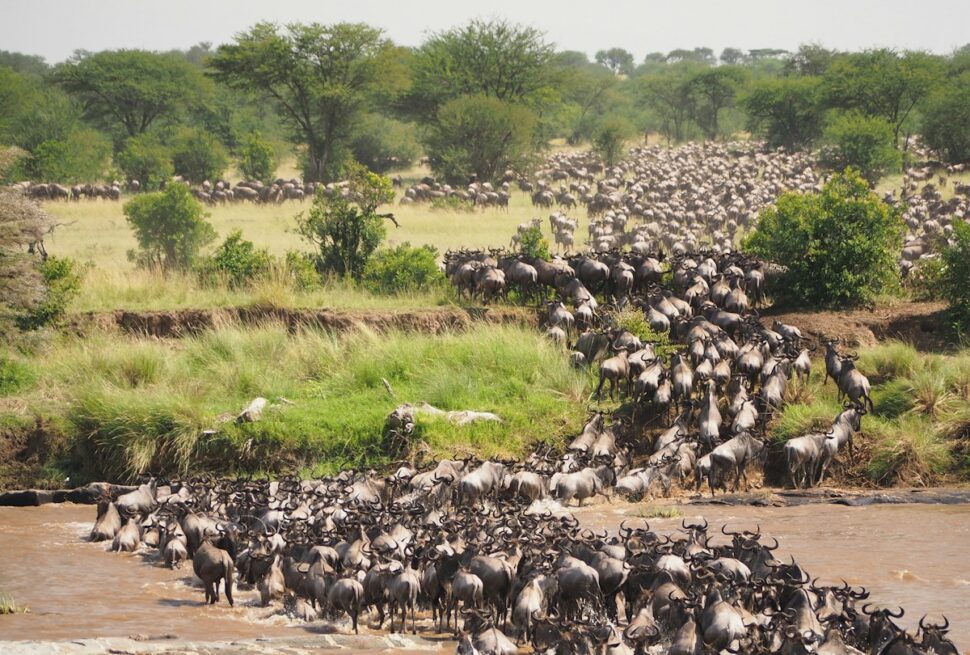
The Serengeti calving season runs from about late January to March, with most births in February, when the migration herds settle on the short-grass plains around Ndutu in the south of the ecosystem. On a good day several thousand wildebeest calves are born, and lions, cheetahs and hyenas hunt the herds at close range.
The hard part is not deciding whether to go, it is choosing the right weeks, the right base and the right budget, because during the Serengeti calving season the herds follow the rain rather than a calendar and the best-placed camps fill months ahead. This guide gives you the timing week by week, where the herds usually gather, what you will see, checked park fees, cost estimates and a sample route from Arusha.

Photo: Divulge Adventures
Quick Facts
- When: the Serengeti calving season runs from late January to March, with the peak of births usually in February
- Where: the Ndutu plains and southern Serengeti, across the Serengeti National Park and Ngorongoro Conservation Area boundary
- What you see: newborn calves, huge herds with zebra, and lions, cheetahs, hyenas and jackals hunting
- Weather: green season with afternoon storms and mostly clear mornings
- Getting there: about 200 km and roughly 5 hours by road from Arusha, or a light-aircraft flight to the Ndutu airstrip
- Park entry: Serengeti US$82.60 and Ngorongoro Conservation Area US$70.80 per adult per 24 hours (checked October 2026)
- Ideal length: 3 nights on the southern plains within a 6-8 day northern Tanzania safari
When Is the Serengeti Calving Season?
The Serengeti calving season usually starts in late January, peaks in February and tails off through March. Most wildebeest cows give birth within a few weeks of each other, so in the peak window the plains can produce several thousand calves a day. Births happen outside these weeks too, but in far smaller numbers.
Ready to go? Book your customized safari instantly on WhatsApp — we'll take it from there.

Instantly on
The timing is set by the short rains. Once the November and December showers turn the volcanic soils of the southern plains green, the herds drift south to graze the short, mineral-rich grass that nursing cows need. A late or patchy rainy season can shift the herds by a week or two, which is why experienced guides follow daily sightings rather than fixed dates.
Serengeti calving season month by month
| Month | Where the herds usually are | What to expect |
|---|---|---|
| December | Moving south from the central Serengeti towards Ndutu | Herds arriving, early births, rain showers |
| January | Ndutu, the southern Serengeti plains and around Lake Masek | Calving begins in the second half of the month |
| February | Ndutu and the short-grass plains of the far south | Peak births and the busiest predator action |
| March | Southern plains, starting to drift west and north | Older calves, fewer births, herds start moving |
| April-May | Central and western Serengeti | Long rains, the herds leave the south and the calving season is over |
If you can only pick one fortnight, the middle of February is the safest bet for the Serengeti calving season. Late January works well too and is slightly quieter. For the wider picture of where the herds are the rest of the year, see our Great Migration month-by-month calendar.
Where Does the Calving Happen?
During the Serengeti calving season, the births take place on the short-grass plains in the far south of the Serengeti ecosystem, centred on the Ndutu area. Ndutu sits just inside the Ngorongoro Conservation Area, on its north-western edge where it meets Serengeti National Park, so a safari here often crosses between two protected areas.

Photo by Ben Preater on Unsplash
The two small soda lakes here, Lake Ndutu and Lake Masek, are useful landmarks, and the woodland around them shelters lions and other predators between hunts. On the Serengeti National Park side, the herds spread across the open plains towards the Kusini and Naabi Hill areas when the grazing is good.
Why Ndutu is good for game drives
Because Ndutu lies within the Ngorongoro Conservation Area rather than the national park, guides there are generally allowed to drive off the tracks to reach a sighting, something that is not permitted in Serengeti National Park itself. That flexibility matters during the Serengeti calving season, when a birth or a hunt is happening a kilometre from the road. Good guides still keep their distance and never cut off a herd or a hunting cat; rules can change, so let your guide decide what is allowed on the day.
The Ngorongoro Conservation Area Authority manages the Ndutu side, while the Serengeti side is run by Tanzania National Parks (TANAPA). Your fees, permits and gate stops follow whichever side you sleep and drive on.
What Can You See During the Calving Season?
The Serengeti calving season gives you three things at once: enormous herds of wildebeest and zebra, newborn calves finding their feet, and predators taking advantage of both. Calves can stand within minutes of birth and keep pace with the herd within about a day, so a birth you watch at breakfast can be over and moving on by lunch.

Photo by Dmitrii Zhodzishskii on Unsplash
Predators on the open plains
Lions, spotted hyenas, cheetahs and jackals all follow the herds onto the southern plains for the whole Serengeti calving season. The short grass gives cheetahs the open ground they prefer, and Ndutu is one of the most reliable places in East Africa to watch them stalk and sprint. Hyena clans hunt at dawn and dusk, and you may see caracal or serval in the longer grass near the woodland edges. Hunts are frequent but unpredictable, so patience pays off more than long distances driven.
Beyond the wildebeest
Zebra foals are born during the Serengeti calving season too, Thomson’s and Grant’s gazelles drop their young on the plains, and giraffes browse the acacia woodland around the lakes. Flamingos sometimes gather on the soda lakes after good rain, and the green season brings migrant birds from Europe and Asia. It is a busy, photogenic time even on days when the herds move out of range.
What Is the Weather Like in the Green Season?
The Serengeti calving season falls in the green season, between the short and long rains. Expect warm, often sunny mornings, building clouds after midday and short afternoon storms on some days. Showers rarely last long, but they can make black-cotton tracks slippery and occasionally cut off a route for a few hours.

Photo: Divulge Adventures
For photographers, Serengeti calving season weather is a gift: clear dawn light for backlit calves, then dark storm skies behind the herds in the afternoon. Bring a rain cover for your camera, a light waterproof jacket and a warm layer for early drives. Our Tanzania safari packing checklist covers the rest, and if your route includes the Ngorongoro Crater rim at around 2,300 metres, plan for cold evenings.
How Many Days Do You Need, and How Do You Get There?
Three nights on the southern plains is the sweet spot for the Serengeti calving season, because the herds can be in a different place each morning and births and hunts reward time on the ground. Most travellers fit those nights into a six to eight day northern Tanzania safari that also takes in Tarangire and the Ngorongoro Crater.
By road, Ndutu is about 200 km from Arusha, roughly five hours of driving before stops, gate formalities and game viewing along the way. Splitting the drive with a night near Karatu or the crater rim makes it far easier. The quicker option is a scheduled light-aircraft flight from Arusha to the Ndutu airstrip, which suits shorter trips or a fly-out at the end.

Photo: Divulge Adventures
A sample eight-day Serengeti calving season route
| Day | Where | Highlights |
|---|---|---|
| 1 | Arusha | Arrive at Kilimanjaro International Airport, rest before the safari |
| 2 | Tarangire | Elephants and baobabs on the way west |
| 3 | Ngorongoro Crater | Full day on the crater floor, night near the rim or Karatu |
| 4-6 | Ndutu plains | Three days with the calving herds and predators |
| 7 | Central Serengeti | Kopjes, big cats and the Seronera valley |
| 8 | Serengeti to Arusha | Short flight back for onward travel or Zanzibar |
This is the shape of our 8 day Tanzania calving season photo safari, and you can shorten it with the 4 day Serengeti wildebeest migration safari if you are short on time. If you are still choosing between the plains and the crater, our Serengeti in January guide compares bases in more detail.
See the calving herds on the Ndutu plains
Our trip gives you three nights in Ndutu during the Serengeti calving season, a full day in the Ngorongoro Crater and a private vehicle with an experienced local guide, tailored to your dates.
How Much Does a Serengeti Calving Season Safari Cost?
A Serengeti calving season safari typically costs about US$250-400 per person per day on a camping budget, US$400-700 at mid-range camps and US$800 or more in luxury camps. These are estimates per person sharing; February is peak season on the southern plains, so prices sit at the upper end of each band.
Park fees are a large slice of any Serengeti calving season bill. The table below shows the main ones for a non-resident adult during the calving months; children aged 5 to 15 pay less. Our full guide to Tanzania park fees explains the seasons and child rates.
| Fee | Amount | Notes |
|---|---|---|
| Serengeti National Park entry | US$82.60 per 24 hours | High-season rate, 16 May to 14 March; US$70.80 from 15 March (checked October 2026) |
| Serengeti concession fee | US$59 per night | October to June rate if you sleep inside the park, usually collected by your camp |
| Ngorongoro Conservation Area entry | US$70.80 per 24 hours | Applies in Ndutu and on the crater rim (checked October 2026) |
| Ngorongoro Crater service fee | US$295 per vehicle | Per descent, shared by everyone in the vehicle |
Fees change from time to time, so always confirm the current rates with TANAPA and the Ngorongoro Conservation Area Authority, or ask us for a quote that lists every fee. Camps on the Ndutu side may also add their own levies, which is another reason to compare all-inclusive prices rather than room rates.
Booking the Serengeti calving season early
The limited number of camps close to the calving grounds is the real constraint. The best-placed lodges and seasonal tented camps for February are often booked six to nine months ahead, so if your dates are fixed, secure your Ndutu nights first and build the rest of the trip around them. Our guide to the best Serengeti camps by area shows which areas suit each month.
Where Should You Stay for the Calving?
Sleep as close to the herds as you can during the Serengeti calving season. A base in Ndutu or a seasonal camp on the southern plains puts you among the calving herds at first light, while a central Serengeti lodge can mean two hours or more of driving each way to reach them.
On the Ndutu side, Ndutu Safari Lodge is a long-running, unfenced lodge of stone-and-thatch cottages overlooking Lake Ndutu, about a kilometre from the airstrip. Lake Masek Tented Camp is a smaller camp of raised tents above Lake Masek, about 20 minutes’ drive from the airstrip. Several mobile tented camps also move onto the southern plains for the season; availability changes every year, so we confirm current options when we quote.
Insider Tips
- Book Ndutu first: lock in your nights on the southern plains before flights and other parks
- Aim for mid-February: it gives the best odds of peak births in the Serengeti calving season, with late January a close second
- Stay three nights: the herds move daily, and births and hunts reward patience
- Start early: be on the plains at sunrise for calm light and active predators
- Pack for storms: rain cover for the camera, waterproof jacket and a warm fleece
- Mix the bases: add a night or two in the central Serengeti for leopards and kopjes
Let us plan your safari
Tell us your dates, budget and dream sightings, and our Nairobi team will send you a free tailor-made itinerary and quote.
Frequently Asked Questions
When is the Serengeti calving season?
The Serengeti calving season runs from about late January to March, with the peak of births usually in February. The exact timing depends on the short rains, so the herds can arrive a week or two early or late. Mid-February gives the best odds, and late January is a good, slightly quieter alternative.
Where is the best place to see the wildebeest calving?
The best place to see the wildebeest calving is the Ndutu area and the short-grass plains of the southern Serengeti. Ndutu lies just inside the Ngorongoro Conservation Area, where it meets Serengeti National Park, and staying there or in a seasonal camp on the southern plains puts you closest to the herds.
How many wildebeest calves are born each day?
At the peak of the calving season, several thousand wildebeest calves can be born on the southern plains in a single day, and hundreds of thousands are born across the season. Most births happen within a few weeks, which helps the herd overwhelm predators. Numbers vary with the rains each year.
Is the calving season better than the river crossings?
The calving season is not better or worse than the river crossings, just different. Calving offers newborn calves, huge herds on open plains and frequent predator action from January to March. The Mara River crossings, from about July to October, offer dramatic crossings but bigger crowds. Pick the one that matches your dates and interests.
How much does a calving season safari cost?
A calving season safari in Tanzania typically costs about US$250-400 per person per day on a camping budget, US$400-700 mid-range and US$800 or more in luxury camps. These are estimates. Park fees include US$82.60 for Serengeti entry and US$70.80 for the Ngorongoro Conservation Area per adult per 24 hours (checked October 2026).
Final Thoughts
The Serengeti calving season is at its best from late January to February, on the Ndutu plains, with at least three nights close to the herds.
Get those nights booked first, add Tarangire and the crater around them, and you have one of the finest wildlife weeks in Africa. If you would like help with dates and camps, our Tanzania safari team can shape a route around the herds for you.
Wondering which February week gives you the best shot at the calving?
Chat with a Divulge Adventures safari consultant on WhatsApp for honest advice, a quick answer and a quote built around you.